![[richard uridge]](https://richarduridge.com/wp-content/uploads/2026/03/Untitled-design-1.png)
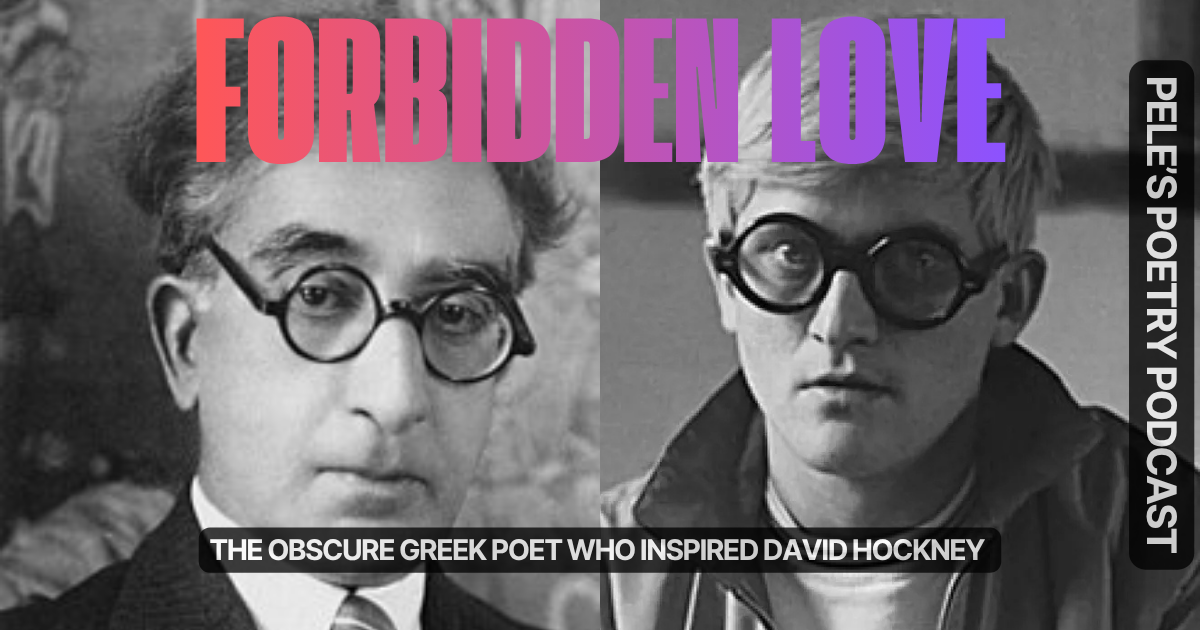

It’s often said that great art begets great art. And that’s certainly the case with the Greek poet, Constantine P Cavafy, whose poetry inspired a young and little known British artist back in the 1960s. The artist is now a household name. His identity? Well if you don’t know already you’ll have to listen to me and Pele Cox reveal all as we explore forbidden love as a source of inspiration for poets from Thom Gunn to Walt Whitman.
I should add that Konstantinos Petrou Kavafis was born to Greek parents in Alexandria, Egypt, but spent a lot of time in England (hence the Anglicised name). He was largely unknown in his lifetime but is now considered one of the most singular Greek poets of the early 20th Century. So let us explain the posthumous turnaround…
Poems
- In The Boring Village by Constantine P Cavafy
- When I Heard at the Close of the Day by Walt Whitman
- Duncan Part 2 from The Man With Night Sweats by Thom Gunn
Notes and further reading
We mentioned Ithaka by Cavafy without reading it. In all of its translations into English, the poem is one of the finest expositions on how life is better enjoyed as a journey rather than a destination.
We planned to read Warming her Pearls by Carol Ann Duffy but with no disrespect to Duffy ran out of time. We also felt, in the moment, that to read the poem would detract from Thom Gunn’s Duncan. It is nonetheless an extraordinary poem so please do take the time to read it if you haven’t before.
I inadvertently called Thom Gunn Thomas. His full name was actually Thomson William Gunn. My apologies.
Credits
The sepia image of Cavafy in pince nez is courtesy of the Constantine Cavafy Museum, Alexandria. The original was by an anonymous artist. The photo is by Fine Art Images/Heritage Images/Getty Images.
The image to Cavafy’s left is, of course, In the Dull Village by © David Hockney. The original plate from which aquatint prints have been made is in the Tate, London.
Recent podcasts
- Christopher Nolan’s take on Homer’s Odyssey is certainly a blockbuster. But, argue Pele Cox and Rich Uridge in the second part of their Odyssey odyssey, it’s also a flockbuster with opinion splitting into two distinct herds. In this bonus episode they also explore whether movie soundtracks can spoil the way our imagination “hears” poetry and […]
- Has Christopher Nolan's blockbuster ignored the fact that The Odyssey was conceived as a poem? If so why? And does it really matter? Pele and Rich discuss.
- The FIFA World Cup gives your hosts, Pele Cox and Rich Uridge, a golden opportunity to explore oral tradition and other strong but less obvious links between football and poetry. All in about the time it takes to get to a hydration break. The perfect warm up for England v Ghana and Scotland v Brazil. […]
- Choosing John Clare, John Keats, Emily Dickinson and Sylvia Plath to explore whether poetry can make you happy isn’t an obvious starting point. All four experienced the very opposite of happiness in their variously and famously tragic lives. So perhaps it was a trick question? But maybe, on reflection, it’s the perfect choice. Make up […]
- Great art begets great art. That’s certainly the case with the Greek poet, Constantine P Cavafy, whose poetry inspired a young British artist – now a household name – as Pele Cox and Rich Uridge reveal as they explore forbidden love as a source of inspiration for poets from Gunn to Whitman. Konstantinos Petrou Kavafis […]
- On the 90th anniversary of his death, Shropshire lad, Richard Uridge and Shropshire lass, Pele Cox, discuss the life and works of the poet, A E Housman. They agree that his poetry is every bit as relevant today as when it was first written at the turn of the 20th century. And they discover that […]
- With Margot Robbie as Cathy in the latest iteration of Wuthering Heights, your hosts argue that without poetry Emily Brontë’s book wouldn’t have been written. So no roles for Robbie and her Heathcliff, Jacob Elordi. No Kate Bush song. No poems of the same name by Sylvia Plath or Ted Hughes. The evidence? Well, Pele […]
- Who first wrote roses are red, violets are blue, honey is sweet and so are you? Who were the lines written for? And when? Plus is poetry the language of love? Just some of the questions Pele Cox and Rich Uridge answer in this special lovers’ edition. Oh and which poet would you take to […]
- What is poetic voice? Is it synonymous with style? Or something else? Perhaps the poet’s “take” on the world? Pele Cox and Rich Uridge seek answers from a range of greats including Emily Dickinson, Edna St Vincent Millay and Vernon Watkins who, with a drunken Dylan Thomas, tripped over a feather! Poets Further reading You can hear […]
- Pele Cox and her co-host Rich Uridge ask: what is the purpose of poetry? With the help of Elizabeth Barrett Browning, Sir Philip Sidney and Sir Thomas Wyatt, they conclude that, in part, poetry’s job is to move readers to virtuous action or “well doing and not well knowing only” as Sidney put it. Along […]