![[richard uridge]](https://richarduridge.com/wp-content/uploads/2026/03/Untitled-design-1.png)
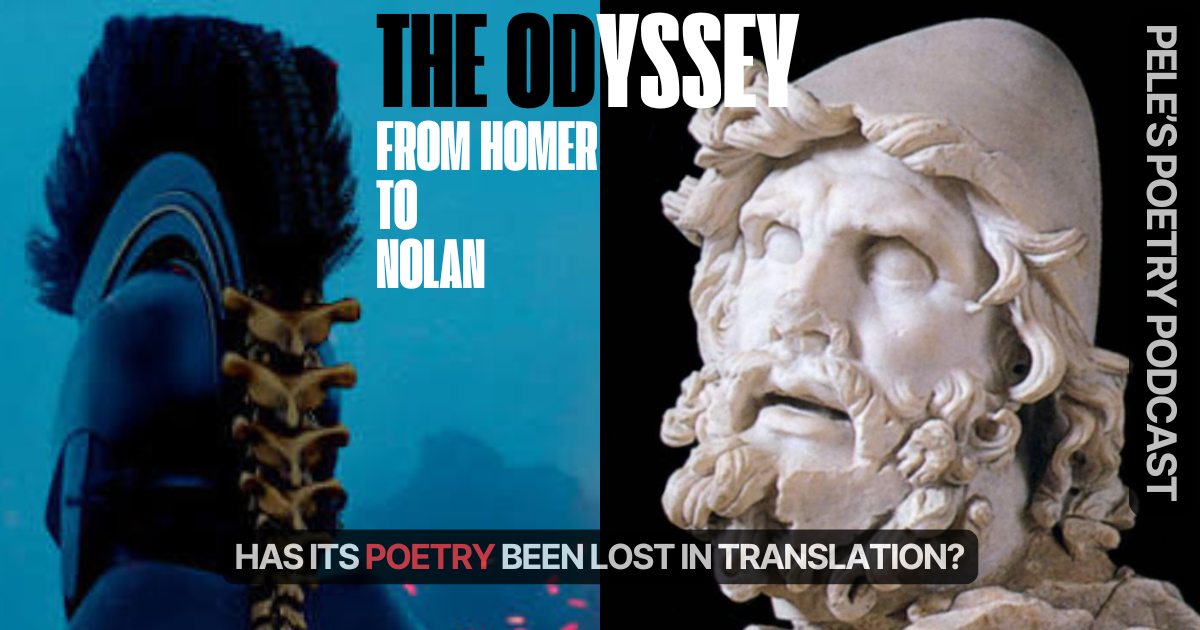

Has Christopher Nolan’s blockbuster film of summer 2026 deliberately ignored the fact that The Odyssey was conceived as a poem? If so, why and does it really matter? Pele Cox and I beg to differ in purist versus pragmatist!
The episode starts with a spoiler alert because even though the original is 2,500 plus years old there are plenty of people who don’t know the story or, rather, stories, plural. It’s complicated. Listen at your peril!
Poems
- The Odyssey – translation by Robert Fagles; Penguin Edition.
- The Odyssey – translation by Emily Wilson; Norton.
- The Odyssey – translation by T E Shaw aka T E Lawrence (of Arabia); Wordsworth Classics.
- Siren Song by Margaret Atwood
- Omeros – Derek Walcott.
- Ithaca – C P Cavafy
Notes and further reading
Nolan’s blockbuster isn’t the first visualisation of Homer’s Odyssey. Nor are any of the others films that have been made over the years. That honour may well go to The Sculptures at Sperlonga discovered in 1957 in the grounds of the villa of the Roman Emperor Tiberius and thought to date back to the 1st century AD. They’re well worth a look.
Pele referenced the work of the academic Ann L T Bergen and the Barbara Clayton book A Penelopean Poetics Reweaving the Feminine in Homer’s Odyssey.
Ulysses by James Joyce got an honourable mention – especially Molly Bloom’s soliloquy.
And so did Ithaca by C P Cavafy who we discussed in our Forbidden Love episode which, if you havent heard it yet we think is well worth a listen (but then we would wouldn’t we)?! There’s a great reading of Cavafy’s Ithaca by Sean Connery that’s worth a listen too, although our view, for what it’s worth, is that the Vangelis soundtrack rather gets in the way of the words.
Recent podcasts
- Christopher Nolan’s take on Homer’s Odyssey is certainly a blockbuster. But, argue Pele Cox and Rich Uridge in the second part of their Odyssey odyssey, it’s also a flockbuster with opinion splitting into two distinct herds. In this bonus episode they also explore whether movie soundtracks can spoil the way our imagination “hears” poetry and […]
- Has Christopher Nolan's blockbuster ignored the fact that The Odyssey was conceived as a poem? If so why? And does it really matter? Pele and Rich discuss.
- The FIFA World Cup gives your hosts, Pele Cox and Rich Uridge, a golden opportunity to explore oral tradition and other strong but less obvious links between football and poetry. All in about the time it takes to get to a hydration break. The perfect warm up for England v Ghana and Scotland v Brazil. […]
- Choosing John Clare, John Keats, Emily Dickinson and Sylvia Plath to explore whether poetry can make you happy isn’t an obvious starting point. All four experienced the very opposite of happiness in their variously and famously tragic lives. So perhaps it was a trick question? But maybe, on reflection, it’s the perfect choice. Make up […]
- Great art begets great art. That’s certainly the case with the Greek poet, Constantine P Cavafy, whose poetry inspired a young British artist – now a household name – as Pele Cox and Rich Uridge reveal as they explore forbidden love as a source of inspiration for poets from Gunn to Whitman. Konstantinos Petrou Kavafis […]
- On the 90th anniversary of his death, Shropshire lad, Richard Uridge and Shropshire lass, Pele Cox, discuss the life and works of the poet, A E Housman. They agree that his poetry is every bit as relevant today as when it was first written at the turn of the 20th century. And they discover that […]
- With Margot Robbie as Cathy in the latest iteration of Wuthering Heights, your hosts argue that without poetry Emily Brontë’s book wouldn’t have been written. So no roles for Robbie and her Heathcliff, Jacob Elordi. No Kate Bush song. No poems of the same name by Sylvia Plath or Ted Hughes. The evidence? Well, Pele […]
- Who first wrote roses are red, violets are blue, honey is sweet and so are you? Who were the lines written for? And when? Plus is poetry the language of love? Just some of the questions Pele Cox and Rich Uridge answer in this special lovers’ edition. Oh and which poet would you take to […]
- What is poetic voice? Is it synonymous with style? Or something else? Perhaps the poet’s “take” on the world? Pele Cox and Rich Uridge seek answers from a range of greats including Emily Dickinson, Edna St Vincent Millay and Vernon Watkins who, with a drunken Dylan Thomas, tripped over a feather! Poets Further reading You can hear […]
- Pele Cox and her co-host Rich Uridge ask: what is the purpose of poetry? With the help of Elizabeth Barrett Browning, Sir Philip Sidney and Sir Thomas Wyatt, they conclude that, in part, poetry’s job is to move readers to virtuous action or “well doing and not well knowing only” as Sidney put it. Along […]